Saturday, November 14, 2015

BALLOONS....


Deborah Howell Gould
with
 Balloons

1949


I hold them for Paris...

Friday, November 6, 2015

MAN IN A CHAIR...


Spirit pictures, faerie photos.
There were various names for these eerie snapshots – regular photographs of regular people doing absolutely regular things. These, though, had shadow images in the background – departed loved ones lurking behind chairs and curtains, tiny winged creatures hovering over heads and shoulders, clusters of wispy fairies prancing on lawns or dancing on palm fronds.
          I don’t have any of them in my collection of old family photographs. I do have a photo of my great-grandparents’ home on Boylston Street that has a faint figure standing in an upper floor window, but I’m pretty certain it was my great-grandmother.
And she was no prancing fairy, I can assure you…


What I do have, though, are lots of photos of men in chairs; it seems to have been a popular pose for formal photographers in the late 1800s and early 1900s: Man in chair, either alone or with wife standing beside him (her hand on his shoulder—oftentimes her left, showing her wedding ring), his children clustered at his feet like decorations.

And casual shots, too.
Here are two of a man in a chair from my collection of old family snapshots; both are of my paternal grandfather, Gardner S. Gould.
This first photo is undated. I have no idea why a rocking chair is plunked in the middle of a tennis court, but I love his knickers, his street shoes, his coat and tie and pipe (I remember the smell of his pipe to this day). This is in the 1920s, I think.

In the second shot, he’s sitting in the afternoon sun in the back yard in Newton; his dog Beans at his feet. It’s September, 1943 (my grandmother penned the date on the back). Casual trousers, shoes and socks, sweater and tie…

We called my grandmother Da, we called him Man.


Here he is: Man in a Chair.

Friday, October 30, 2015

Two Black Cats...

Happy Halloween!

Evelyn (whoever she was) sent this postcard to Mr. Oliver King of Stonington, Connecticut – she mailed it from Providence, Rhode Island, on October 27, 1915.

“Many thanks,” she wrote, “for the pretty card. You are certainly a very swift traveler. It must seem nice to be able to be in two places at once. I wish I could, I would be in Attleboro now. Hope this finds you well…”

I love this card. I found it at a flea market a few years ago and bought it without question. Am curious about how Oliver could be in two places at once (it’s a good trick, isn’t it?).

Full moon rising up over the silhouette of the city; the backyard board fence; that hunched black cat…
          …and look at the spelling: Hallowe’en!
          I know it’s All Hallow’s Evening (or Eve), which is the start of a three-day observance called Allhallowtide, a time of remembering the dead, including saints (hallows).

No matter: I’ll leave the dead alone – there will be too much life on the streets here! Sidewalks will be thick with children, all costumed up to beat the band! Ghosts and pirates and the current rages – princesses and zombies—staggering up and down the street, going from house to house to collect candy.
          And I’ll stand at my doorway with my bowl of little Almond Joys, admire the costumes and smile understandingly at the Patient Parents who wait at the end of my driveway for their little goblins…(I’ve always wanted to hand stiff drinks to the parents, but…)


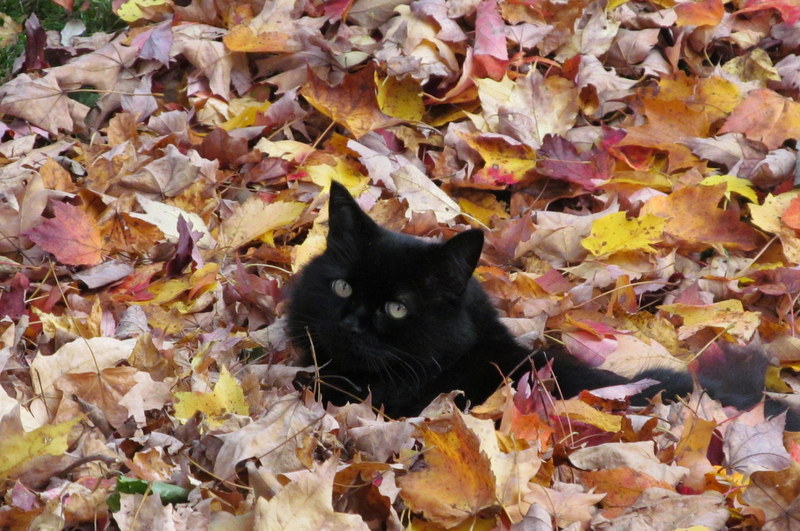
 I don’t need the hunched black cat on the postcard, for I’ve got my own. He is 13 years old now, and he’ll be hiding in the rose bushes, wide-eyed and hair-raised, for most of the evening! He’s never perched on a board fence in his entire life, and he’d rather spend the night inside at the foot of my bed than outside with all those screeching children!

So Happy Halloween to all of you from Howard…

          …and me.   

Friday, October 16, 2015

ONE and FOUR...

I looked at the Sepia Saturday prompt photo for three days; I stopped by computer several times every day to take another look, but couldn’t find a theme that intrigued me.
Radios? I thought; three pictures on the wall? Clocks, or sailor collars? Boys and girls? Ornate chair backs? Children’s furniture? Stuffed animals, dolls? Blonde children?
A certain slant of light and shadow?

And then it came to me: one adult, four children…


This is the summer of 1949; I am almost three years old.
That’s my aunt Hope sitting down; she’s got me on her knees in the center of the photograph. My brother John (6) is on the right, and my cousins Martha (7) and Sheila (5), investigating something on my right shoulder, to the left.

We’re at my grandparents’ summer house in Jaffrey, New Hampshire; it’s probably the first week in August, when Hope and her children overlapped with my mother and us every summer—they lived in Pennsylvania and we lived in Maine, so it was the only time we saw each other as children.

I can almost feel the sunlight on the side of my face.

Just out of range, behind my brother, is the pile of clean, white sand we used to play in for hours—my grandmother supplied us with measuring cups, spoons, tinware; she collected coffee cans and little pails and scoops for us. When we were older, we built enormous cities (with roads and bridges, houses, etc.) in that sandpile. We pulled small pine seedlings from the woods and stuck them along our roads (landscaping); built twig fences and such!
But at this stage of the game, I liked eating that sand more than playing with it, so was guarded at all times by a Responsible Adult.

Today is my 69th birthday, so this photo was taken sixty-six years ago; it’s hard for me to see myself in that little blonde girl, but if I look very carefully, I can find myself in her eyes, her mouth…


Happy birthday to her…

Friday, September 18, 2015

SCRUB-A-DUB-DUB...

Washing machines.
One day last August I loaded my clothes, added the soap, then closed the lid; I turned the dial to the “Regular Wash” cycle, aimed the little arrow at “start” and pushed.
          The washer started the spin cycle.
          I stopped the machine, turned the dial, lined everything up again and pushed again – this time, it started the spin cycle, but added water to the whole thing.
          The third time around, I got agitation, but no water.
There was no fourth time; I went to the laundromat in town.


Over a hundred years ago, the Charles Williams Stores in New York offered a washing machine called the Sunny Monday Double Rubber Washer!
“The clothes to be washed are put into the tub between the lower and upper rubbers…practically the same movement as the one used in washing clothes on the washboard…”
          They’re not talking about rubber as we know it—they’re talking about two wooden rollers inside the machine that “rub” the clothes back and forth whenever you move that bizarre handle on top.
It’s only $2.45, for goodness’ sake!


Sears, Roebuck offered The Dolly Wonder – a “big family” size tub of one-inch cedar. Operated by electric motor, it “will do the family washing week after week and month after month easily and economically.” It was equipped with a power wringer with semi-soft rolls; a wide, reversible drain board. Only $51 if you pay in cash; the credit terms were $5 down and $5 per month…but the interest pushed the cost of the machine up to $56.25.


But, omygoodness, look at the 1931 Wardway Electric Gyrator Washer from Montgomery Ward!
          “The new, improved Gyrator Agitator swirls and forces the hot soapy water through the clothes…women everywhere tell us that no rubbing is necessary!”
          It has an all-copper tub that holds 6-8 cotton sheets; it has a strong ¼ horsepower splash-proof electric motor; its gears push the clothes back and forth AND up and down!
          Mrs. L.E. Davis of Tippecanoe City, O, writes “Under your easy payment plan, one pays so easily that it is not noticed.
          Best of all, the Wardway comes with a 10-year guarantee (with ordinary family use).


Wish I’d had a 10-year guarantee on my 2011 machine…

Friday, September 11, 2015

IT'S NOT THE WINE ITSELF...

…it’s about the wine coaster.
          I remember this one from my grandmother’s dining room table.
Dinner could be formal there: I had to wear a dress, white ankle socks (that always sagged) and black strapped shoes--remember Mary Janes? I knew which fork to use, which spoon; had a napkin as big as a pillowcase and my very own wine glass (never used, of course, but at my place, nevertheless!)
Eating dinner with the adults was pretty boring – I couldn’t understand much of the conversation – I much preferred to eat in the kitchen with Mrs. Sagan.

But, I digress; back to the wine coasters…
She had three or four of them for her two, fine stoppered cut glass decanters with an H (for Howell) etched on the side of the bowls; the decanters themselves were lovely, but I was more fascinated with the stoppers than with any other part of this arrangement.

        
The coasters were  sterling silver with wooden bottoms. At any dinner, there might be one or two on the table—one for a decanter of red wine, one for white—and they prevented drips/stains on the tablecloth. They also kept the decanters apart to prevent chipping the crystal.
          The term “coaster” didn’t make any sense to me until I learned that coasters with wooden bottoms were slid across the tablecloth to diners who needed refills; after-dinner coasters had felt backings so that those who lingered after the dinner had been cleared and the table cloth removed, could slide decanters back and forth across the bare tabletop without scratching the surface.
          Old coasters—made in the 17th and 18th centuries, were less than five inches in diameter; when broader-bottomed cut glass decanters came into fashion, decanters became larger, too. In huge dining rooms, coasters sometimes had actual wheels to make it easier to slide the length of enormous tables – they were called wine carriages!


I have this single felt-backed coaster and one of the decanters. I have no idea where the others might be; I’m hoping they’re with second or third cousins, somewhere, gracing their tables.

Friday, September 4, 2015

BUILDING BRIDGES...


Isn’t she beautiful?
         
This photograph—one of the first color ones in my family collection—has lived in every house I’ve ever owned.
Literally.
This is the drawbridge at Osterville, Massachusetts. I think it connected the points of land between the North and West Bays in Osterville Harbor, but I’m not so sure of that.
My father, the engineer in charge, was working on this bridge in October of 1946 when he received word I had been born: He drove to Boston to meet me, then came back a couple of days later to finish up the bridge.
It’s been known as “Deb’s Bridge” in my family ever since!

The last time I saw that bridge was in the very early 1960s when I was sailing with my family on the Trident; I was about fifteen years old. I stood on the bow with the horn and called the approach for the bridge keeper – I remember his singular response—a conversation, of sorts; an agreement between us—and then the slow, lovely ascent of the draw.
          We passed through; I made my way to the stern and watched the descent from there.
          My father’s bridge, I thought.


I’d like to think it’s still there…